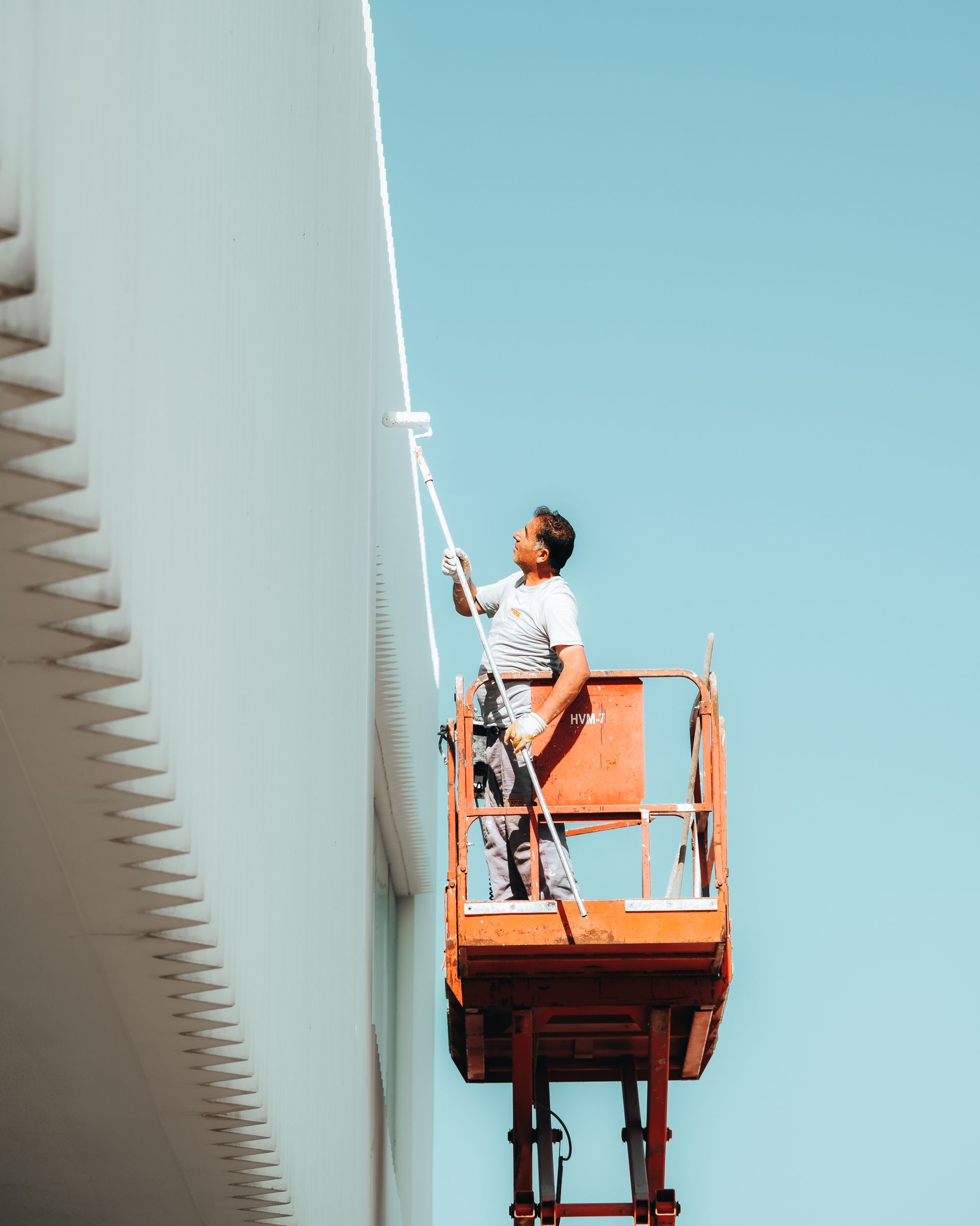
Painters in Abbotsford, BC
Stucco, siding, trim and interiors across the Fraser Valley — from Clearbrook and Townline Hill out to the Matsqui Flats and Sumas Prairie.
Abbotsford is not the coast, and exterior paint knows it. The city sits at the western end of the Fraser Valley — Langley to the west, Mission across the river, Chilliwack to the east and the Sumas border crossing along its southern edge. Summers here are hot and genuinely dry: at Abbotsford International Airport, July and August daily highs average close to 25°C, and those two months are the driest of the year, at roughly 39 mm and 47 mm of rain out of about 1,505 mm across the whole twelve.
That matters more than it sounds. Long dry spells, hard afternoon sun and almost no shade on the valley floor mean coatings flash off faster here than nearer the water. Cut lines have to be kept wet, and big stucco elevations get chased around the house with the sun rather than straight into it. Working with that is most of the job.
The workable exterior season runs from late spring into early autumn, and it is longer and more dependable than it is nearer the water. May and June are fine, July and August are the best weeks of the year for stucco and siding, and September usually holds. By mid-October the valley fog settles in off the prairie and overnight temperatures drop below what exterior coatings want — surfaces stay damp past mid-morning and adhesion turns into a gamble. The good weeks fill up early. Coatings and prep are covered on our exterior painting page.
Abbotsford did most of its growing recently: the merged city counted over 105,000 people at the 1996 census, the year after Matsqui and Abbotsford amalgamated, and past 153,000 by 2021 — and a great deal of that build-out is stucco. Drive Clearbrook, Townline Hill, Sandy Hill or Aberdeen and you see acrylic and cement stucco house after house, usually with a brick or stone skirt at the base and painted fascia, soffit and trim.
Stucco is not a surface you simply roll over. Done properly it means washing off chalk and mildew, cutting out and patching hairline cracks, spot-priming bare repairs so they don't flash through, and a masonry-rated coating laid on heavy enough to bridge the texture rather than sit on the peaks. It also means telling you the truth: paint solves a coating problem, and only hides a moisture one.
At roughly 375 km², Abbotsford is the largest city by area in British Columbia, so the name covers very different buildings. In the middle, Historic Downtown, the City Centre, the UDistrict around the University of the Fraser Valley, Mill Lake and the apartment and townhome blocks of Clearbrook and West Clearbrook are older and denser — work there goes suite by suite, or a building at a time. East and uphill, Eagle Mountain, Auguston, Sandy Hill and the slopes of Sumas Mountain are newer detached housing with wide stucco elevations and tall gable ends that need real access equipment, not a ladder and optimism.
North and west it turns rural fast: Matsqui and the Matsqui Flats, Mount Lehman and Bradner are farmland and acreages. South and east, Sumas Prairie is the flat, drained bed of the former Semá:th Lake, pumped dry in the early 1920s and still held that way by dikes and the Barrowtown pump station — as the November 2021 flood reminded everyone. Out there, full sun, wind and no shelter are the working conditions, and the buildings are not only houses.
Abbotsford is one of the most intensively farmed places in the country: on the 2021 Census of Agriculture its farms record the highest sales per hectare of any city in Canada, and dairy, poultry and eggs together make up roughly half of the city's farm-gate receipts. Behind that sit metal-clad barns, poultry sheds, equipment shops, berry-field sheds and board-and-batten outbuildings — buildings most painting companies quietly leave off the list. We spray them: the right primer for galvanised or weathered steel, a coating chosen for UV and washdown rather than sheen, and enough masking that the overspray stays on the building it belongs to.
We walk the actual elevations — including the ones you only see from the back field — and send a clear written quote within 24 hours.
Pressure wash off chalk, mildew and valley dust, cut out and patch cracks, then spot-prime every bare repair so nothing flashes through.
On hot days we start on the shaded side and follow the shade around, so the coating levels out instead of skinning over.
We check every elevation with you and touch up before we call it done — backed by our 2-year workmanship warranty.
Late spring to early autumn, and July and August are the best two months of the year here — Abbotsford's driest, averaging roughly 39 mm and 47 mm of rain, with daily highs close to 25°C. On hot afternoons we work the shaded side first so the coating levels instead of skinning over. Book in spring for a summer slot.
Yes — most Abbotsford stucco takes paint well. It needs a proper wash to pull off chalk and mildew, hairline cracks cut out and patched, bare repairs spot-primed, and a masonry-rated coating laid on heavy enough to cover the texture. What paint cannot do is fix water getting in behind the stucco. If we see signs of that, we will tell you rather than cover it up.
Most full exteriors run three to seven days depending on how much prep the surfaces need, and stucco with a lot of cracking sits at the longer end. We commit to a start and finish date in writing before we begin.
Yes. We cover the whole city — Matsqui and the Matsqui Flats, Mount Lehman, Bradner, Sumas Mountain and the Sumas Prairie — as well as neighbouring Mission and Chilliwack. Acreage properties and farm buildings are part of what we do, not an exception to it.
Direct sun. Abbotsford gets a hotter, brighter summer than the coast, and south and west elevations take years more UV than the shaded sides. That shows up as chalking, fading and a dull, powdery feel. It is normal, and it is one reason we quote a full elevation rather than patching one wall to a colour that no longer matches.
Climate figures: 1991–2020 Environment and Climate Change Canada normals for Abbotsford International Airport. Population: Statistics Canada censuses of 1996 and 2021. Farm figures: 2021 Census of Agriculture.
Get your free, no-obligation written quote within 24 hours — and get your name down before the dry weeks fill up.
 Painters in Langley
 Painters in Surrey
 Painters in White Rock